Hungary Has More to Offer the Wine World Than Sweet Aszu
The white wine region centered in Tokaj and surrounding villages such as Mad have historic claim to some of the world’s greatest sweet wines called Tokaj Aszu. In the 17th century French King Louis XIV proclaimed the wine… “wine of kings, king of wines”. But this prestigious wine region is more than just sweet wines. For the last several decades producers have been introducing quality dry, still and sparkling white wines focused on one of its native grapes – Furmint, that thrives in the unique terroir of the area.
Visiting the Tokaj Wine Region
Tourism is flourishing with Budapest becoming one of the major travel destinations in Central Europe. The Tokaj wine region is approximately 115 miles northeast of Budapest so it is a definite full day commitment to visit. Driving there is rather easy but with strict DUI rules it is not recommended as a means of transport if you will be tasting wines at several wineries. A private tour with an educated wine guide is usually my preferred choice. However, in performing extensive due diligence for visiting this region one rather annoying item surfaced. These formalized tours are based on departure and return from Budapest. TripAdvisor reviews of these tours are all highly favorable, whether private or small group. However, they also come with a “mysteriously” consistent 750 Euro (roughly $870.00) cost, per person. A rather hefty price for most of us.
An affordable alternative to enjoy this excellent wine region is transportation via train. Direct trains from Budapest to Tokaj with returns operate nearly every hour, taking less than three hours each way and cost around $16.00 per person. With an overnight stay and convenient taxi service between Tokaj and Mad, this wine excursion becomes a very relaxing, affordable adventure. But absolutely book any tastings ahead of time before making this excursion as there are very few places in Tokaj or Mad that accept walk-ins.
The Wineries
Two wineries that I highly recommend are Demeter Zoltan, located in Tokaj, https://www.demeterzoltan.hu/en/home/ and Szepsy, located in Mad, https://www.szepsy.hu/ . The former winery was founded in 1996, but the family can trace its noble roots to 1642 when Ferdinand I awarded their ancestor for his fighting against the Ottoman Empire, while the latter’s family wine-making history dates back to the 16th century.
Demeter Zoltan
Demeter Zoltan and his wife Anett are of the younger generation of rising stars taking the production of both still, sparkling and aszu wines to greater heights while maintaining the historic production roots of this wine region. They operate from a house built in 1790 that was originally a bakery in the town of Tokaj. With grapes from nine vineyards throughout the Tokaj wine region, totaling approximately seven hectares or seventeen acres, their focus is on producing distinct wines based on the unique terroir of each of their vineyards. Anettt handles the business and marketing side of the operations and her level of knowledge and courteous demeanor as she conducts the tastings of five various wines in their portfolio is impressive. And as a homage to the bakery origins of the house, she typically spends hours baking bread that is presented during the tasting. Either as single varietals or blends of five of the approved grapes for the region, the array of wines truly highlight their terroir-driven distinctiveness, boding well for the future of Hungarian producers as they move beyond just the production of aszu wines.
Szepsy
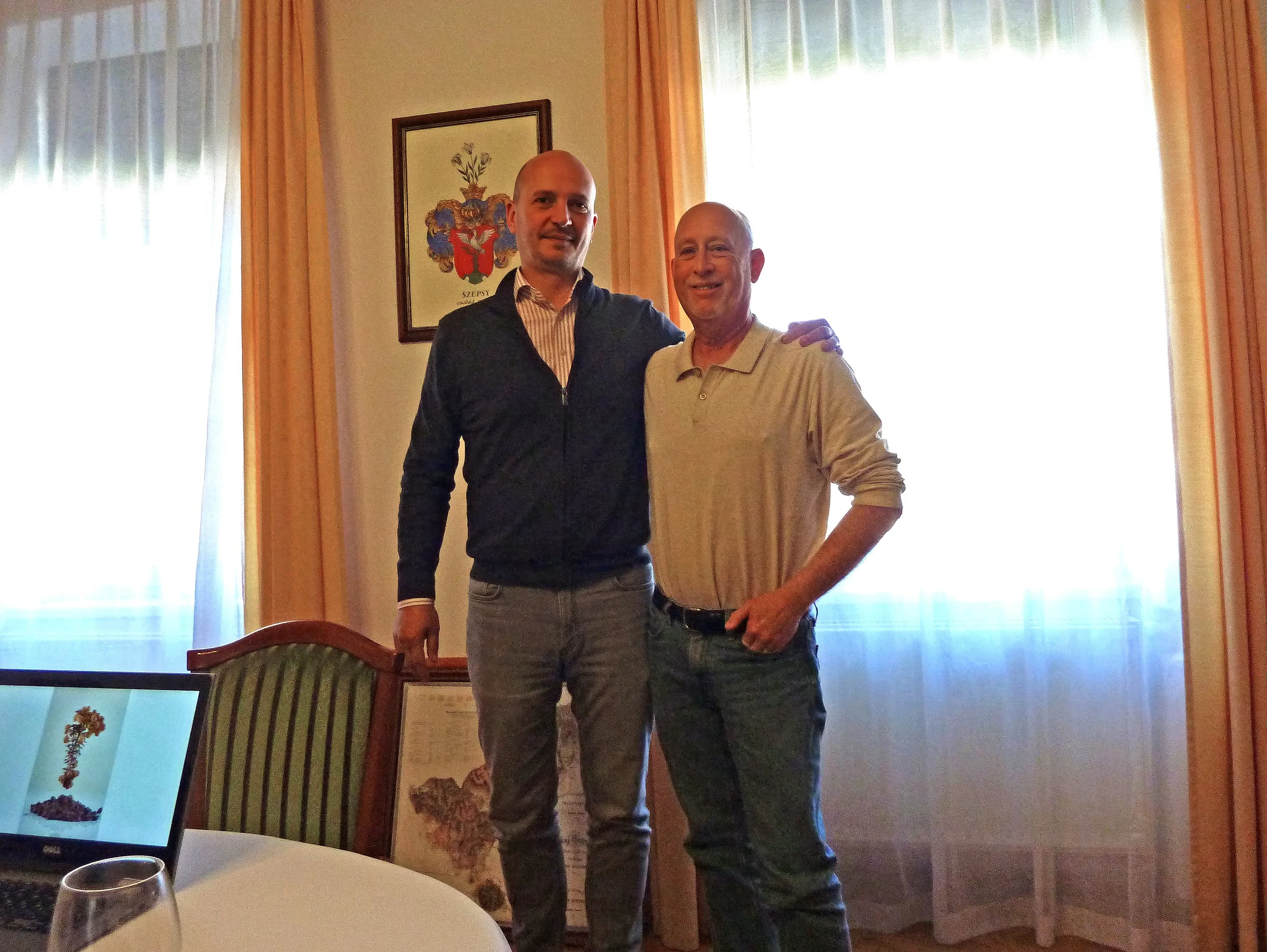
At times I am overly enthusiastic or outrightly intimidated when meeting the owners of famous family wineries. I melted when meeting and having a picture taken with the daughter and current manager of Guiseppe Quinterelli, considered the godfather of Amarone wines from Veneto; and was speechless in a brief handshake with Giovanni Gaja of Gaja wine fame. When visiting Szepsy the realization that this family is the Hungarian version of the famed Antinori family of Toscano with both tracing their roots to the 16th century, I was flat-out awe inspired.
Brief History
You cannot have a conversation regarding Hungarian wines and specifically, aszu without talking about Szepsy. Ancestor Szepsy Lasko Mati, in 1631, is regarded as the first to produce wine in the aszú style.
In the last half century, István Szepsy is recognized as a leading figure in Hungarian winemaking. During the Communist era aszu production was based on quantity, not quality. Istvan secretly maintained a semblance of traditional production methods in small amounts for local consumption during this time. With the collapse of the Communist bloc in 1989, Istvan led the drive to reintroduce the ancient methods of Aszu production focused on the primary grape, Furmint to which he became the leading expert. But he was instrumental in introducing modern techniques in the vineyard with a deep focus on geological mapping of the various distinctive terroirs of the region to best identify the Furmint clones best suited for each vineyard. With methodical acquisition of small vineyards of the highest quality throughout the Tokaj wine region, he expanded the family holdings to its current 37 hectares, roughly 91 acres across 22 vineyards. He was also one of the leading forces beyond the creation of the Royal Tokaj Wine Company which is one of the largest in Hungary with its aszu wines widely distributed throughout the United States.
The family tradition is fortunately continuing with Istvan Jr. and his sister Gabi splitting duties running the business from their headquarters in Mad. While Aszu is the past, present and remains the future, the introduction of dry, still whites centered on Furmint and other indigenous white grapes may well be where Hungary’s global wine future will ultimately settle.
To have shared a private tasting conducted by Istvan, Jr, who has a low-key but proud recognition, carrying on the family’s heritage, while taking the time to convey both the technical and historic aspects of this incredible family is something I will cherish.
Food Pairings for Aszu and Furmint Wines
The sweetness of aszu wines pair well with cheeses such as Blue, Gorgonzola, Roquefort and Stilton. It is also an excellent complement to foie gras. On the dessert side I find aszu especially good with fruit-oriented desserts and cheesecake either plain or with fruit toppings.
Furmint is a dry, crisp, light-bodied, low alcohol wine with high acidity and green apple aromas. If you have had French Chablis, Albariño or Alvarinho from Spain or Portugal, respectively, Furmint is in this category. In the old saying of “what grows together, goes together, Furmint pours well with the famous Hungarian dish Chicken Paprikash (which is a rather easy dish to make at home). Sparkling wines based on Furmint pairs with shellfish dishes like shrimp, mussels and clams, while dry Furmint pairs with most baked chicken dishes and white fishes, especially those with a creamy sauce. Like its French, Spanish and Portuguese counterparts, Furmint can be served with softer cheeses such as: Feta, Chevre, Brie, Camembert and Fontina.
Where to Purchase Demeter Zoltan and Szepsy Wines
Demeter Zoltan wines are more readily available in the United States than Szepsy. A quick search via https://www.wine-searcher.com will identify various retailers currently selling its wines. If you want to find if their wines are available in your particular state, it is best to get in contact with their importer, Danch & Granger Selections https://danchandgranger.com that is located in the Bay Area.
Szepsy is a highly-allocated wine primarily sold in restaurants including several Michelin-rated in the States. If you want to purchase their wines on a retail level, or direct from the importer where legally permitted, please reach out to their importer, Rev Wine Merchants https://revwinemerchants.com/ or you can call them at 917.519.4990.